SanHoDo Budo
A Three-Path Approach to Modern Martial Development
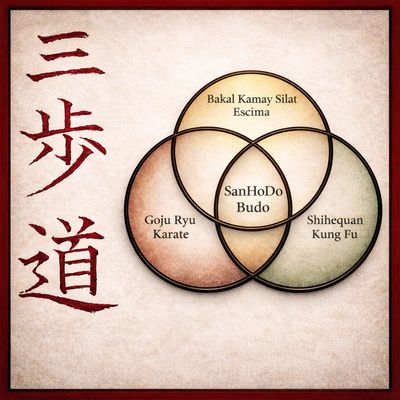
SanHoDo is a modern martial art system built on the idea that true martial development must be structured, progressive, and principle-driven. The name “SanHoDo” translates loosely as “The Way of Three Paths” (San = three, Ho = method/path, Do = way). It reflects a training philosophy that integrates three essential dimensions of martial growth into one unified system.
Rather than focusing solely on techniques, SanHoDo emphasizes how and why techniques function.
The Philosophy Behind SanHoDo
SanHoDo was developed to create clarity in martial progression. After years of training across multiple systems, its structure was designed to:
- Remove unnecessary complexity
- Emphasize functional mechanics
- Develop body unity and efficiency
- Blend traditional principles with modern application
At its core, SanHoDo recognizes that a martial artist must develop more than skill alone. The system organizes training into three complementary paths based off of three different martial arts.
Influences and Structure
SanHoDo draws inspiration from traditional striking arts, structural systems, and principle-based martial philosophy.
Training is progressive, with each level building upon foundational mechanics before advancing into more complex applications.
What Makes SanHoDo Unique
Unlike systems that rely heavily on memorization of forms alone, SanHoDo emphasizes:
- Understanding movement mechanics
- Functional repetition
- Application under pressure
- Internalizing principles over choreography
The goal is not to create performers — it is to develop adaptable martial artists.
The Modern Warrior Approach
SanHoDo trains the modern martial artist to:
- Move efficiently
- Strike with structure
- Think under pressure
- Lead with integrity
It is a system designed not only to preserve tradition, but to refine it for today’s practitioner.